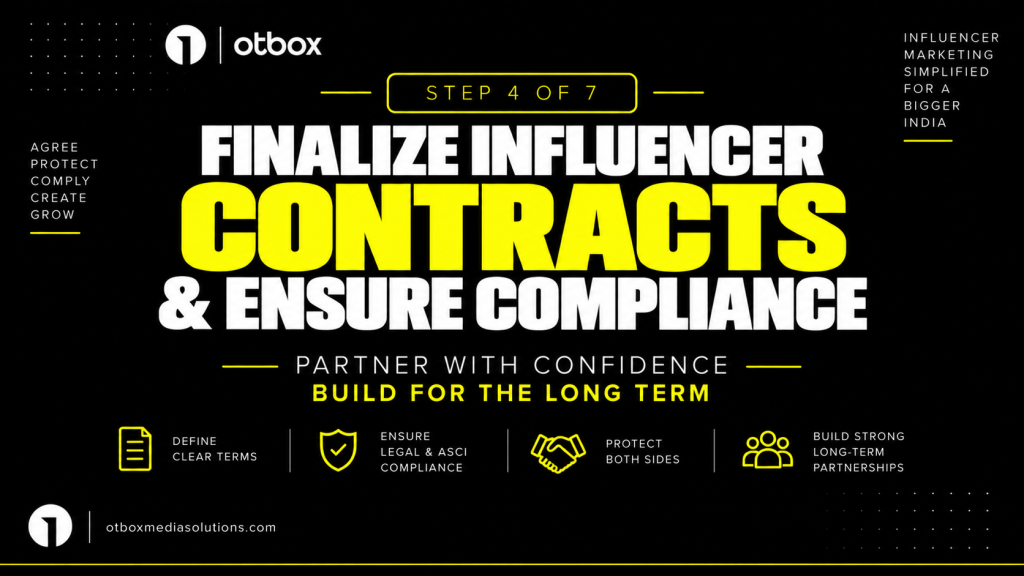
Influencer contracts, Handshake deals and DM agreements might feel casual and creator-friendly, but they’re how campaigns end up in legal disputes or compliance violations.
A clear contract protects both parties and ensures everyone delivers what they promised. In this post, I’ll show you exactly what to include in your influencer agreements—and how to navigate India’s advertising regulations without getting flagged. India’s influencer marketing sector is projected to reach INR 3,375 crore by 2026, growing at 18% CAGR, driving the need for solid contracts as brands scale up.
🎯 Specify Deliverables with Crystal Clarity
Specificity prevents disappointment. Your contract should detail every aspect of content creation and delivery.
📋 What to Include
Content format and quantity: Don’t write “Instagram content.” Write: “Three Instagram Reels (60 seconds each), five Instagram Stories (total campaign narrative), one YouTube Short (30 seconds).”
Platform and placement: Where the content goes live, whether cross-posting is allowed, and if you get rights to repurpose. Example: “Primary posting on Instagram feed and Stories. Creator may cross-post to Facebook. Brand receives rights to repost on brand Instagram account.”
Content specifications:
- Required elements: product shots, key messages, hashtags, disclosures
- Optional elements: creator’s personal story, specific filming locations
- Creative freedom areas: music choice, editing style, exact wording
Timeline and posting schedule:
- Draft submission dates
- Number of revision rounds included
- Approval timeline (e.g., brand provides feedback within 48 hours)
- Go-live dates and specific times
Example: “First draft due March 15, 2025 by 6 PM IST. Brand feedback by March 17. Final content by March 19. Go-live March 20 at 7 PM IST.”
Performance requirements: How long must content stay live? Standard is 30-90 days for feed posts, 24 hours minimum for Stories. Specify: “Feed content must remain live for minimum 60 days post-publication. Creator may not delete or archive before June 1, 2025.”
Usage rights: This is critical. Can you repost on your brand channels? Use in paid ads? Include in website content? For how long?
⚠️ Negotiate usage rights upfront—retroactive negotiations get expensive. When a piece of content performs well and you want to turn it into an ad, having usage rights pre-negotiated saves weeks of back-and-forth. Platforms like Chtrbox use AI for seamless creator-brand matching and contract management, streamlining these negotiations.
Example usage rights clause: “Brand receives perpetual rights to repost content on owned social channels (Instagram, Facebook, YouTube). Brand receives 6-month rights for paid advertising across Meta platforms. Content may be featured on brand website for 12 months. Creator retains copyright and may use content in their own portfolio.”
⚖️ Understanding ASCI Compliance for Indian Campaigns
Compliance isn’t optional, and ignorance isn’t a defense. The Advertising Standards Council of India (ASCI) has specific guidelines for influencer marketing that both brands and creators must follow, with recent updates emphasizing stricter disclosure standards.
✅ Mandatory Disclosure Requirements
Every piece of branded content must include clear, upfront disclosure. This is non-negotiable.
Acceptable disclosure labels:
- #ad
- #sponsored
- #collaboration
- #partnership
What doesn’t count: Burying disclosure in a wall of 30 hashtags, using vague terms like #grateful or #blessed, or putting it after the “more” cutoff in captions.
👁️ Placement and Visibility Rules
Instagram posts: Disclosure must appear in the first two lines of the caption (before “read more” cutoff). Must also use Instagram’s built-in “Paid Partnership” tag.
Instagram Stories: Text overlay with disclosure in the first frame, or verbal disclosure in the first 3 seconds of video.
YouTube: Disclosure must appear in the first 10 seconds of the video (verbal or text overlay) and YouTube’s disclosure checkbox must be enabled.
General rule: Use language the audience understands. If your target audience speaks Hindi primarily, consider Hindi disclosures like #विज्ञापन.
🚨 What Happens With Non-Compliance
- Content takedown requests
- Public naming in ASCI reports
- Legal penalties and fines
- Damage to brand reputation
- Loss of consumer trust
Make compliance a non-negotiable part of your brief and contract. Include specific language: “Creator agrees to comply with all ASCI guidelines for influencer disclosure, including visible #ad or #sponsored tags in the first two lines of all captions and use of platform-specific disclosure features.”
⚠️ It’s your responsibility as the brand to ensure creators follow these rules. “But they didn’t disclose properly” doesn’t protect you when ASCI comes calling. An emerging trend is AI-driven compliance tools for real-time monitoring of disclosures in regional languages.
💰 Payment Terms That Work for Both Parties
Money conversations should be crystal clear before any work begins. Ambiguity here causes more relationship breakdowns than creative differences.
💵 Payment Structure Options
Flat fee per deliverable: Most common for first-time brand-creator partnerships. Simple, predictable, low-risk for both sides. Example: ₹25,000 for one Instagram Reel.
Performance-based: Base fee plus commission on sales/conversions generated. Example: ₹15,000 base + ₹500 per sale using creator’s unique code. Aligns incentives but requires robust tracking.
Product exchange: Only appropriate for nano-influencers and lower-value products. Most professional creators expect monetary compensation.
Hybrid models: Reduced fee + product + performance bonus. Example: ₹20,000 + ₹5,000 product value + 10% commission on sales. Balances guaranteed payment with performance upside.
📅 Payment Timeline Standards
Standard practice: 50% advance upon contract signing, 50% upon content approval or publication.
Larger campaigns: May structure as 30% at signing, 40% at draft approval, 30% at publication.
Important: Never do 100% payment upfront unless you have an established relationship. And never do 100% payment after publication—creators need cash flow too.
Include payment terms explicitly: “50% advance (₹12,500) payable within 5 business days of contract signature via bank transfer/UPI. Remaining 50% (₹12,500) payable within 5 business days of content going live.”
🔄 Revision Policy
Nothing causes more friction than unclear revision expectations.
Include in your contract: “Fee includes two rounds of revisions based on adherence to brief requirements. If creator follows brief specifications and brand requests changes beyond brief scope, additional revisions will be charged at ₹5,000 per round or by mutual agreement.”
This protects creators from endless revision cycles while ensuring you can get necessary adjustments.
🔐 Rights and Exclusivity
Content ownership: Typically creators retain copyright but grant you usage rights (as specified earlier).
Exclusivity clause: Can they work with competitors? For how long after your campaign?
Standard exclusivity: “Creator agrees not to promote competing brands in [product category] for 30 days before and 60 days after content publication.”
⚠️ Be reasonable. You can’t expect a beauty influencer to avoid all skincare brands for six months because you ran one campaign. Specify your direct competitors. Real-world successes like Mamaearth’s authentic reviews with mommy bloggers show how clear exclusivity boosts trust and sales.
🎯 Your Action Step
Add these 5 critical clauses to your draft contract:
- Deliverables specification: Exact content formats, quantities, platforms, and timeline
- Payment terms: Structure, amounts, timeline, and payment method
- Usage rights: What you can do with content, where, and for how long
- ASCI compliance requirement: Specific disclosure language and platform requirements
- Revision policy: How many rounds included and what happens beyond that
Review it from the creator’s perspective. Is everything clear? Would you sign this contract if you were them?
💡 If you’re working with established influencers, expect them to have their own contract template or requested modifications. That’s professional and normal—negotiate in good faith.
📖 Missed reading Step 3 about Choosing the right Influencer?
🎉 Coming up in Step 5: We’ll walk through content production and the approval process. You’ll learn how to maintain quality standards while respecting creator expertise, plus how to handle delays, wrong messaging, and necessary reshoots.