Did you know over 76% of Forbes India’s Top 100 Digital Stars failed to disclose paid collaborations in ASCI’s 2024 dipstick study, up from 69% the previous year? Recent analysis reveals that Indian influencers risk hefty fines and shattered audience trust when they skip proper disclosure. Fashion creator Priya Sharma learned this the hard way—paying ₹50,000 last year for undisclosed Instagram Reels ads.
Here’s the thing: ASCI Guidelines for Influencers India aren’t optional suggestions anymore. They’re the compliance framework protecting both your audience and your career in India’s booming ₹3,600 crore influencer marketing ecosystem.
What Are ASCI Guidelines for Influencers India?
The short answer? ASCI Guidelines for Influencers India are mandatory disclosure rules requiring you to clearly label any sponsored content, paid partnerships, or material connections with brands. Think of them as your legal obligation to tell your audience when you’re being paid to promote something.
The Advertising Standards Council of India (ASCI) launched these guidelines to tackle a critical problem: consumers couldn’t tell genuine recommendations from paid advertisements. According to legal experts, the Guidelines for Influencer Advertising in Digital Media—updated most recently in April 2025—exist to protect consumer trust and curb misinformation in digital advertising.
Who Do These Guidelines Apply To?
Every influencer operating in India falls under these rules, regardless of follower count. Whether you’re a nano-influencer with 2,000 followers or a celebrity with millions, ASCI Guidelines for Influencers India apply when you:
- Receive payment (cash, bank transfer, cryptocurrency) for promoting products
- Accept free products, services, or travel in exchange for coverage
- Earn affiliate commissions from links in your content
- Hold equity or employment relationships with brands you mention
- Create content as a virtual influencer (yes, AI-generated personas must disclose their non-human nature)
The official ASCI framework makes one thing crystal clear: if there’s a material connection that might influence your audience’s perception, disclosure isn’t negotiable.
Why Should You Care Right Now?
India’s influencer marketing sector is projected to grow 25% in 2026, and data shows that 90% of Indian consumers make purchase decisions based on influencer endorsements. That’s massive reach—and massive responsibility.
But wait—there’s a compliance crisis. ASCI processed 1,409 influencer violations through November 2025, with 94% involving disclosure failures. The Consumer Protection Act (CCPA) now backs ASCI’s guidelines with legal teeth, meaning violations can trigger government penalties beyond ASCI’s own enforcement.
Your actionable takeaway: Bookmark ASCI’s official guidelines at ascionline.in/social/guidelines and check them before every sponsored collaboration. If you’re receiving any benefit that could influence your content, assume you need disclosure.
The 5-Step ASCI Disclosure Checklist Every Influencer Needs
Compliance doesn’t have to be complicated. Follow this step-by-step process to align with ASCI Guidelines for Influencers India and avoid the 94% non-compliance trap:
Step 1: Identify Your Material Connection
Before posting anything, ask yourself: “Am I receiving something of value for this content?”
Material connections include:
- Direct payment from brands or agencies
- Free products (even if you weren’t asked to post about them)
- Affiliate commissions from trackable links or discount codes
- Gifted experiences like hotel stays, restaurant meals, or event tickets
- Employment or equity relationships with the company
- Family connections to the brand owner
Legal analysis confirms that even if a brand didn’t explicitly ask for a post, receiving free products creates a material connection requiring disclosure.
The test: Would your audience assume you’re giving an unbiased opinion? If the answer is “maybe not,” you need disclosure.
Step 2: Choose the Right Disclosure Label
ASCI Guidelines for Influencers India accept several disclosure formats, but they must be unmistakably clear:
- #Ad – The universal standard for paid promotions
- #Sponsored – When a brand paid for the content
- #PaidPartnership – Instagram’s built-in label (more on this below)
- #Promotion – Alternative to #Ad
- #Collab or #Partnership – Only if combined with #Ad or #Sponsored
According to ASCI’s official guidance, vague labels like #Collab, #Thanks, or #Gift alone don’t meet the standard. Your audience shouldn’t need to decode your disclosure.
Pro tip: When in doubt, use #Ad—it’s recognized globally and leaves zero room for misinterpretation.
Step 3: Place Disclosure Where It Can’t Be Missed
Here’s where most influencers fail: burying disclosures in a sea of hashtags or placing them after “read more” buttons.
ASCI mandatory disclosure requirements demand:
- Instagram posts: #Ad in the first line of your caption, before any line breaks
- Instagram Stories: #Ad overlay text visible throughout the entire Story
- Instagram Reels: #Ad in the caption AND audible mention in the first 3 seconds
- YouTube videos: Verbal disclosure in the opening 10 seconds PLUS written disclosure in the description’s first paragraph
- YouTube Shorts: #Ad in the title or pinned comment
Studies indicate that ASCI rejected 94% of non-compliant cases specifically because disclosures were hidden, delayed, or unclear. Don’t let your disclosure be the footnote—make it the headline.
Step 4: Verify Your Qualifications for Specialized Content
This is new territory. ASCI’s April 2025 updates introduced strict rules for health and finance content through Addendum 2.
If you’re promoting financial products or health advice, ASCI Guidelines for Influencers India now require:
- Financial influencers (finfluencers): Display SEBI registration number, CA credentials, or CFP certification prominently
- Health influencers: Show medical qualifications (MBBS, nutritionist certification, fitness trainer credentials)
- Disclaimer requirement: Explicitly state “This is not personalized advice—consult a professional”
Legal experts note that unqualified influencers can no longer give financial or medical advice, even with disclosure. Recent regulatory analysis confirms that SEBI and IRDAI can take direct action against unlicensed advisors.
Your move: If you lack credentials, stick to sharing personal experiences with clear disclaimers. Never position yourself as an expert in regulated fields without proper qualifications.
Step 5: Conduct Pre-Publication Audits
Before you hit “post,” run this final compliance check:
- Disclosure visibility test: Show your draft to someone unfamiliar with your content. Can they spot the disclosure in 3 seconds?
- Label accuracy: Does your disclosure match the actual relationship? (Don’t use #Gifted if you were paid)
- Platform compliance: Did you use platform-specific tools like Instagram’s “Paid Partnership” tag?
- Qualification check: For health/finance content, are credentials displayed?
- Advertiser verification: Did the brand approve your disclosure approach?
Industry data reveals that brands share compliance responsibility—they must ensure influencers follow sponsored content rules India. Smart brands now use monitoring tools like BigBang.Social’s compliance verifier to audit influencer posts.
Implementation tip: Create a Google Doc checklist you copy for every sponsored post. Make it a non-negotiable part of your content workflow, like editing or scheduling.
Platform-Specific ASCI Guidelines: Instagram vs YouTube Disclosure
Different platforms demand different disclosure tactics. Here’s how to nail ASCI Guidelines for Influencers India across the two biggest influencer platforms:
Instagram Disclosure Requirements
Instagram offers built-in compliance tools, but you still need to understand the nuances:
For Feed Posts:
– Use Instagram’s “Paid Partnership” tag (Settings → Add Paid Partnership Label)
– Include #Ad in the first line of your caption as backup
– The tag creates a header reading “Paid partnership with [Brand]”—impossible to miss
For Instagram Reels Disclosure:
– Enable “Paid Partnership” tag (appears at the top of the Reel)
– Add #Ad to the caption’s first line
– Mention the partnership verbally in the first 3 seconds of audio
– Place text overlay reading “Paid Partnership” if the Reel is watched on mute
For Stories:
– Use the “Paid Partnership” sticker or text overlay
– Keep the disclosure visible for the entire Story duration
– Avoid placing it where profile pictures or UI elements might hide it
ASCI’s official guidance emphasizes that Instagram’s built-in tools satisfy disclosure requirements when used correctly—but many influencers still fail by skipping the verbal or caption components.
YouTube Disclosure Best Practices
YouTube’s longer format demands more comprehensive disclosure:
For Standard Videos:
– Verbally disclose in the opening 10-15 seconds: “This video is sponsored by [Brand]”
– Check YouTube’s “Includes paid promotion” box (appears as a banner on the video)
– Write disclosure in the description’s first paragraph, before the fold
– Pin a comment with #Ad if the video includes affiliate links
For YouTube Shorts:
– Include #Ad or #Sponsored in the title or first line of description
– Mention the partnership verbally in the opening seconds
– Use text overlay for the first 2-3 seconds
– Pin a disclosure comment immediately after posting
The key difference:Compliance experts point out that YouTube’s longer watch times mean viewers might skip ahead—verbal disclosure at the start ensures they can’t miss it.
Quick Platform Comparison Table
| Element | Instagram (Reels/Posts/Stories) | YouTube (Videos/Shorts) |
|---|---|---|
| Primary Label | “Paid Partnership” tag + #Ad in caption | “Includes paid promotion” checkbox + verbal disclosure |
| Timing | Visible from frame one | Verbal mention in first 10 seconds |
| Backup Disclosure | #Ad in first caption line | #Ad in description’s first paragraph |
| Audio Requirement | Recommended for Reels | Mandatory for all video content |
| Platform Tool | Built-in “Paid Partnership” tag | “Includes paid promotion” setting |
Your actionable takeaway: Don’t rely solely on platform tools. Layer multiple disclosure methods—tag, caption, verbal, visual—to guarantee compliance across viewing contexts (sound off, description collapsed, etc.).
Understanding Consequences: What Happens When You Ignore ASCI Guidelines
Let’s talk about what’s at stake when you skip ASCI Guidelines for Influencers India. The consequences fall into three categories: regulatory penalties, brand relationship damage, and audience trust erosion.
Regulatory Penalties and Legal Risks
ASCI operates as a self-regulatory body, but it’s backed by government enforcement through the Consumer Protection Act (CCPA):
ASCI’s Enforcement Process:
1. Consumer complaints or proactive monitoring flags your content
2. ASCI’s National Advertising Monitoring Service (NAMS) reviews the violation
3. You receive a notice to modify or withdraw the content
4. Non-compliance gets escalated to government authorities
5. CCPA can impose fines up to ₹50 lakhs and ban endorsements for up to 3 years
Data from ASCI’s monitoring efforts shows they processed 1,409 influencer violations through November 2025, with 94% involving disclosure failures. The council’s CEO, Manisha Kapoor, stated: “Influencers must be held accountable for misleading consumers.”
Real-world impact: Fashion influencer Priya Sharma’s ₹50,000 penalty for undisclosed Reels ads isn’t an isolated case—it’s becoming the norm as enforcement intensifies.
Brand Partnership Consequences
Brands are increasingly sophisticated about influencer marketing compliance. When you violate ASCI guidelines, you risk:
- Contract termination: Most influencer agreements now include ASCI compliance clauses with penalty provisions
- Payment withholding: Brands can legally refuse payment for non-compliant content
- Blacklisting: Industry databases track compliance failures, making future partnerships harder to secure
- Legal liability: Brands can sue influencers for damages if violations trigger regulatory action against the company
According to industry analysis, major brands now use automated monitoring tools to scan influencer content for compliance before releasing payment.
Audience Trust Erosion
This is the hidden cost that compounds over time:
When audiences discover undisclosed sponsorships, they feel deceived. A 2024 consumer trust survey found that 73% of Indian social media users said they’d unfollow influencers who hide paid partnerships. That’s not just one lost post—it’s diminished credibility affecting all your future content.
The trust recovery paradox: Rebuilding audience trust takes 10x longer than building it initially. One undisclosed partnership can require months of transparent behavior to overcome.
How to Implement Self-Regulation and Avoid Penalties
Don’t wait for ASCI to find you. Build these preventive controls into your workflow:
Quarterly Compliance Audits:
– Review your last 90 days of content
– Verify every sponsored post includes proper disclosure
– Check that disclosures meet current ASCI Guidelines for Influencers India (guidelines evolve—what worked last year might not suffice now)
– Document your audit with screenshots for your records
Contract Review Protocol:
– Before signing brand deals, verify the contract includes clear disclosure requirements
– Confirm who’s responsible for compliance monitoring (you, the brand, or both)
– Ensure payment isn’t contingent on hiding the partnership
Team Training:
If you work with managers, editors, or virtual assistants, ensure they understand sponsored content rules India. One team member’s mistake becomes your liability.
Monitoring Tools:
– Set Google Alerts for your name + “ASCI” to catch any complaints
– Use compliance checkers like BigBang.Social’s verification tool
– Subscribe to ASCI’s newsletter for guideline updates
Your implementation step: Schedule your first quarterly audit today. Block 2 hours in your calendar, review your recent content, and fix any disclosure gaps before ASCI finds them.
Your ASCI Compliance Cheat Sheet: Quick Reference Guide
Bookmark this rapid-reference checklist for instant compliance verification before every post:
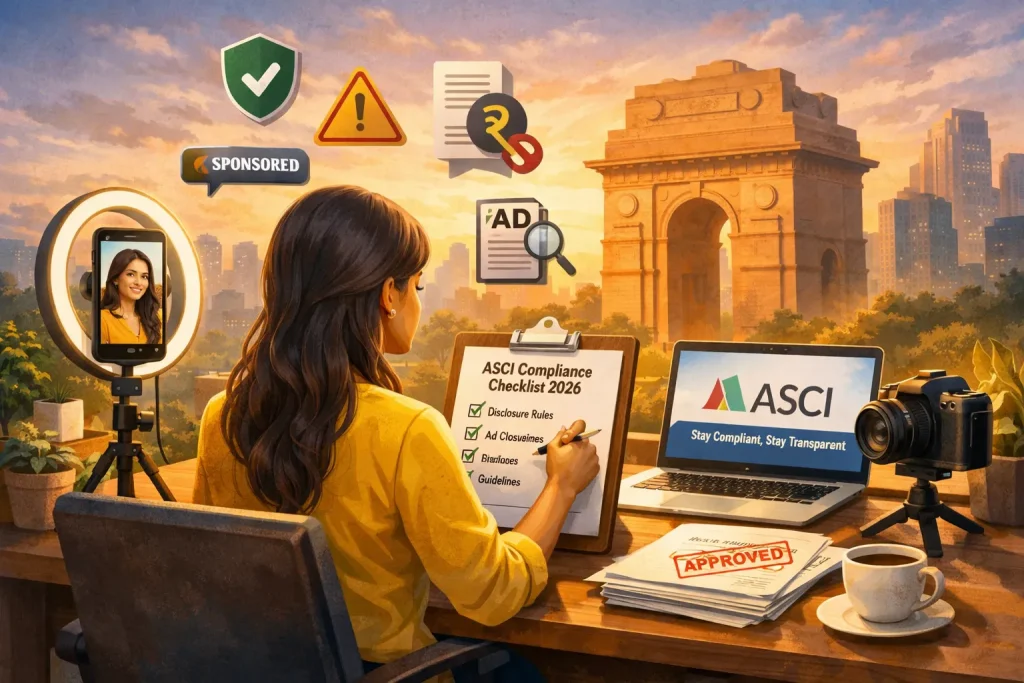
Pre-Post Disclosure Checklist
✓ Material Connection Confirmed
– [ ] I’m receiving payment, products, services, or other benefits
– [ ] The relationship could influence my audience’s perception
– [ ] This qualifies as sponsored content under ASCI Guidelines for Influencers India
✓ Disclosure Label Selected
– [ ] Using #Ad, #Sponsored, or #PaidPartnership
– [ ] Label is clear, not vague (#Collab alone doesn’t count)
– [ ] Platform-specific tools enabled (Instagram’s “Paid Partnership” tag, YouTube’s checkbox)
✓ Placement Optimized
– [ ] Disclosure appears in the first line of caption/description
– [ ] Verbal mention in the first 3-10 seconds of video content
– [ ] Text overlay visible throughout Stories/Reels
– [ ] Not hidden behind “read more” or buried in hashtag lists
✓ Specialized Content Verified
– [ ] If health/finance content: credentials displayed
– [ ] Disclaimer added: “Not personalized advice—consult a professional”
– [ ] No claims outside my qualified expertise
✓ Platform Requirements Met
– [ ] Instagram: “Paid Partnership” tag + #Ad in caption + verbal (for Reels)
– [ ] YouTube: Checkbox + verbal disclosure + description text + pinned comment (if affiliate links)
– [ ] Cross-posted content includes disclosure on every platform
Red Flags That Signal Non-Compliance
Watch for these warning signs that your disclosure might fail ASCI mandatory disclosure standards:
- Disclosure appears after the 3rd line of caption
- Using only #Collab, #Thanks, #Gift, or #Spon
- No verbal mention in video content
- Credentials missing on health/finance posts
- Disclosure only in comments, not the original post
- Vague language like “in partnership with” without #Ad
Monthly Compliance Maintenance
Make these practices routine:
Week 1 of each month:
– Review ASCI’s website for guideline updates
– Check if new platforms (TikTok India return, new apps) have specific requirements
– Update your disclosure templates with any regulatory changes
Week 3 of each month:
– Audit the previous month’s sponsored content
– Verify all disclosures remain visible (captions weren’t edited to remove them)
– Document compliant posts in a compliance log
Quarterly:
– Deep-dive audit of all content relationships
– Review contracts to ensure they align with current ASCI Guidelines for Influencers India
– Training refresh for any team members
Essential Resources to Keep Handy
Save these links for instant access:
- ASCI Official Guidelines: ascionline.in/social/guidelines
- ASCI Complaint Portal: For checking if complaints exist against your content
- Platform-Specific Tools:
- Instagram: Settings → Account → Branded Content
- YouTube: Video Details → “Includes paid promotion”
Your next step: Share this checklist with your management team, save it to your phone’s notes app, and reference it before every sponsored post. Compliance takes 2 minutes per post—penalties take months to resolve.
Remember—ASCI Guidelines for Influencers India exist to protect both you and your audience. Embrace them as the professional standard they are, and you’ll build an influencer career that’s not just profitable, but sustainable and penalty-free.
The question isn’t whether you can afford to comply—it’s whether you can afford not to. Want to read about Tracking and Optimizing Influencer Marketing Campaigns, read here
TL;DR
• Audit your last ten posts: add ASCI Guidelines for Influencers India disclosures immediately.
• ASCI Guidelines for Influencers India mandate #Ad in first caption line every post.
• ASCI Guidelines for Influencers India require verbal sponsorship disclosures within first 10 seconds.
• Create a Google Doc checklist for ASCI Guidelines for Influencers India compliance workflow.
• ASCI Guidelines for Influencers India demand health and finance credentials plus clear disclaimers.
For more information or to get in touch with us, please feel free to reach out to OTBOX at otboxmediasolutions@gmail.com