Did you know 65% of India’s online shoppers live outside metros? Meet the creators who speak their language.
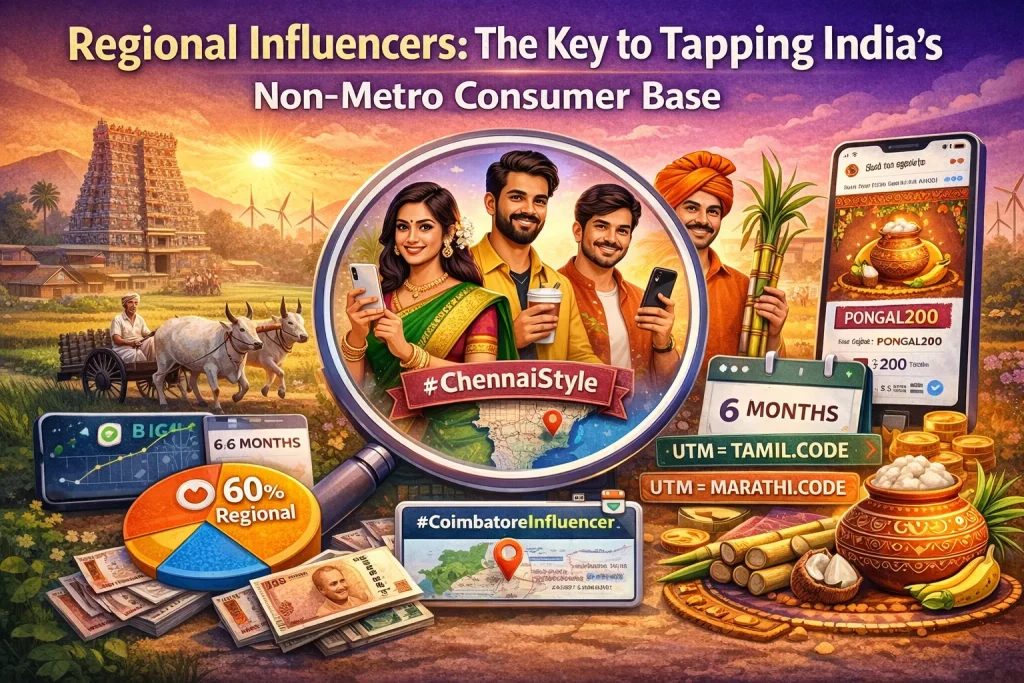
While brands chase celebrity partnerships in Mumbai and Delhi, the real gold rush is happening in Coimbatore, Indore, and Patna. Regional Influencers India are unlocking a ₹2,850 crore market in 2025—projected to hit ₹3,375 crore by 2026—by connecting with 300 million non-metro consumers in the languages they actually speak. Studies indicate that vernacular content drives 2–3x higher engagement than English, yet most marketers still overlook Tier 2 and 3 cities where trust, cultural nuance, and local dialects determine purchase decisions.
Here’s the thing: your next growth curve isn’t in saturated metros. It’s with creators who know that Pongal sells better than Valentine’s Day in Tamil Nadu, and that a Marathi food blogger from Nashik commands more loyalty than a Mumbai macro-influencer.
Why Regional Influencers India Are the Key to Tier 2 & 3 Growth
Why prioritize local creators over celebrity endorsements? Because authenticity beats reach when you’re targeting non-metro India.
Regional Influencers India deliver measurable advantages that macro-influencers simply can’t match in smaller cities:
-
Engagement That Actually Converts: Micro-influencers with 2,000–50,000 followers achieve 4–6% engagement rates—60% higher than celebrity partnerships—because their audiences see them as neighbors, not billboards. Data reveals this translates to 2–5% conversion rates in regional campaigns, compared to sub-1% for generic national pushes.
-
Trust Built on Shared Identity: When a Tamil creator discusses skincare in Coimbatore slang or a Marathi mom-blogger reviews kitchen gadgets using local references, 70% of their followers trust recommendations as peer advice, not advertising. This cultural resonance drives purchase intent in ways English content never will.
-
Untapped Market Scale: India now has 3.5–4.5 million content creators growing at 22% annually, with the majority operating outside metros. You’re not competing for attention in an oversaturated space—you’re entering blue ocean territory where local influencer marketing India strategies yield higher ROI at lower cost-per-engagement.
Actionable takeaway: Allocate 40–60% of your influencer budget to micro-creators speaking Tamil, Marathi, Telugu, or Kannada. Their niche authority in Tier 2 cities delivers better ROAS than splitting budgets across pan-India celebrity campaigns. You can read more about strategic budget allocation at Micro vs Macro Influencer Budget in India: Where to Invest for Maximum Impact.
How to Find and Vet Regional Influencers India in Tamil, Marathi & Beyond
How do I find Tamil influencers who actually move products? Start where your customers already scroll—platform-specific searches filtered by language and geography.
Most brands struggle because they apply metro discovery tactics to non-metro markets. Here’s your five-step scouting process:
Step 1: Use Geo-Targeted Hashtag Research
Search Instagram and YouTube for #TamilBeauty, #MarathiMom, #TeluguFoodie combined with city tags like #CoimbatoreInfluencer or #PuneFashion. Twitter’s advanced search lets you filter by language and location—critical for finding creators whose audiences match your target demographics.
Step 2: Prioritize Engagement Metrics Over Vanity Follower Counts
A creator with 8,000 followers and 6% engagement (480 interactions per post) outperforms one with 80,000 followers and 1% engagement (800 interactions). According to recent analysis, Regional Influencers India in the micro-tier deliver 4–6% rates consistently because their communities are tightly knit around shared language and local culture.
Step 3: Validate Authenticity Through Content History
Scroll back six months. Do they post consistently in regional languages? Do comments reflect genuine conversations (not generic emoji spam)? Tools like HypeAuditor flag fake followers, but manual review reveals cultural fit—does this creator understand local festivals, slang, and consumer pain points?
Step 4: Check Audience Demographics Against Your Buyer Persona
Request Instagram Insights or YouTube Analytics showing follower locations and age ranges. If you’re targeting women 25–40 in Tier 2 Tamil Nadu cities, verify the creator’s audience matches—not just language, but actual geography and gender splits.
Step 5: Start With Paid Trials Before Long-Term Contracts
Negotiate a single sponsored post or Story series. Track UTM-coded links and promo codes to measure direct attribution. The 75% of regional brands reporting sales boosts do so because they test-and-learn rather than committing blindly.
Actionable takeaway: Build a vetted database of 15–20 Regional Influencers India per target language, categorized by niche (beauty, food, parenting, tech). Update quarterly as engagement patterns shift. You can read more about systematic influencer discovery at The Ultimate Guide to Finding the Right Influencer in India.
Hey Google, how do I vet a local influencer? Check their engagement rate (aim for 4%+), review six months of content for consistency, verify audience demographics match your target cities, and run a paid trial campaign with trackable links before scaling.
Crafting Language-Specific Campaigns with Regional Influencers India
What’s the secret to campaigns that feel local, not translated? Co-creation in native dialects with cultural calendar integration.
Here’s where most brands fail: they write English briefs, ask for Tamil translations, and wonder why engagement tanks. Successful multilingual influencer strategy starts with the creator’s voice, not your corporate messaging.
Mini Case Study: ThiraiGlow’s Tamil Beauty Breakthrough
ThiraiGlow, a Chennai-based skincare brand, partnered with five Coimbatore micro-influencers (6,000–15,000 followers each) ahead of Pongal 2024. Instead of product spec sheets, they sent samples and asked: “How would you explain this to your sister?”
The creators filmed Reels in Coimbatore Tamil—not Chennai Tamil—discussing ingredients using local metaphors (“turmeric like what Paati uses”) and tied launches to Pongal gifting traditions. ThiraiGlow provided festival-themed packaging but let influencers script everything.
Result: 3x regional sales uplift, 18% higher engagement than English campaigns, and user-generated content they repurposed for six months. The brand spent ₹1.2 lakh on five influencers versus ₹8 lakh quoted for a single metro macro-influencer—with better returns.
Best Practices for Regional Campaign Execution
Respect Dialect Variations: Tamil spoken in Madurai differs from Coimbatore or Chennai. Brief creators to use their natural speech patterns, not standardized textbook Tamil.
Integrate Local Festivals and Events: Tie product launches to Pongal, Ganesh Chaturthi, Onam, or regional harvest festivals. A Marathi influencer promoting kitchen appliances during Gudi Padwa resonates deeper than a generic Diwali push.
Co-Create Scripts, Don’t Dictate: Provide key messages and let Regional Influencers India adapt tone, examples, and delivery. Their audience trusts their voice—your job is guardrails, not scripts.
Use Regional Visual Cues: Backgrounds, props, and even color palettes should reflect local aesthetics. A Kerala food blogger’s kitchen setup differs from a Punjabi creator’s—authenticity lives in these details.
Actionable takeaway: Develop campaign briefs as conversation starters, not mandates. Schedule 30-minute calls with each creator to discuss cultural angles, then let them produce first drafts you refine collaboratively. You can read more about creating effective collaboration frameworks at Build an Influencer Brief That Gets Results (Step 2 of 7).
Measuring Success: What’s the Best Way to Measure Regional Influencer ROI in India?
How do you prove Regional Influencers India campaigns drive revenue, not just likes? Combine geo-segmented sales tracking with native-language sentiment analysis.
Standard influencer metrics (reach, impressions) don’t capture non-metro nuances. Here are the four KPIs that matter:
1. Geo-Attributed Sales Lift
Use UTM parameters and unique promo codes tied to specific cities. If a Tamil influencer’s code shows 400 redemptions in Coimbatore and Madurai but only 20 in Chennai, you’ve validated hyper-local impact. Cross-reference with your e-commerce platform’s city-level sales data for the campaign period versus prior months.
2. Engagement Rate in Target Languages
Track comments, shares, and saves—but analyze sentiment in the creator’s native language. Research shows that Tamil comments saying “நான் இதை வாங்கினேன், நல்லா இருக்கு” (I bought this, it’s good) predict conversions better than generic English “Nice!” responses. Use tools like Sprinklr or native speakers to categorize sentiment.
3. Cost Per Acquisition by Region
Calculate total campaign spend (creator fees + product costs + management) divided by new customers acquired in target Tier 2/3 cities. Benchmark: Regional Influencers India campaigns should deliver ₹150–₹400 CPA in non-metros versus ₹600+ for metro campaigns, given lower competition and higher trust.
4. Repeat Purchase Rate from Influenced Cohorts
Tag customers acquired via influencer codes in your CRM. Track 60-day and 90-day repeat rates. If Regional Influencers India drive 25–35% repeat purchases versus 15–20% from paid ads, you’ve found sustainable growth, not one-time spikes.
Actionable takeaway: Build a dashboard tracking these four metrics per creator, per campaign, per region. Review monthly to identify top performers worth long-term partnerships and underperformers to cut. You can read more about comprehensive ROI measurement frameworks at How to Calculate Influencer Marketing ROI: A Step-by-Step Guide for Indian Brands.
Your Regional Influencer Roadmap: Next Steps
Regional Influencers India aren’t a trend—they’re the strategic edge for brands serious about India’s next 300 million online shoppers. While competitors chase metro saturation, you can build authentic communities in Tamil Nadu, Maharashtra, Telangana, and Karnataka through creators who speak the language of trust.
Start small: Pick one language, one Tier 2 city, and three micro-influencers for a 60-day pilot. Measure ruthlessly using geo-attributed sales and native sentiment. Scale what works, kill what doesn’t.
Download our free Regional Influencer Brief template to map your first campaign—complete with vetted discovery tactics, co-creation frameworks, and measurement dashboards tailored for non-metro India.
Bookmark this guide and share it with your team. The brands winning Tier 2 and 3 markets in 2026 are the ones building regional influencer strategies today.
TL;DR
• Allocate 40–60% of influencer budget to Regional Influencers India in Tamil and Marathi.
• Use geo-targeted hashtags like #CoimbatoreInfluencer to discover niche Regional Influencers India quickly.
• Vet creators’ authenticity by reviewing six months of regional-language content and true comments.
• Run paid trials with unique UTM and promo codes for geo-attributed sales tracking.
• Co-create scripts in native dialects; integrate local festivals like Pongal for authentic engagement.
For more information or to get in touch with us, please feel free to reach out to OTBOX at otboxmediasolutions@gmail.com