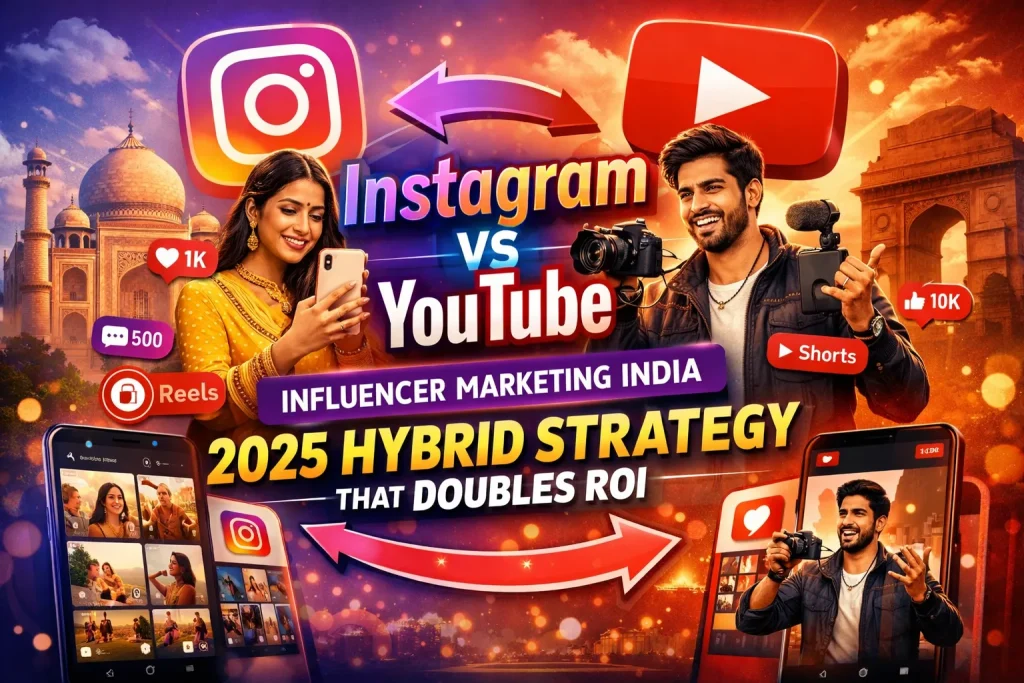
Here’s the thing: choosing between Instagram vs YouTube influencer marketing India isn’t the right question anymore. Brands that pit these platforms against each other leave money on the table, while savvy marketers who blend Reels and Shorts into a unified strategy are seeing 2× higher customer loyalty and engagement rates that outpace single-platform campaigns by 29%.
The landscape has shifted dramatically. With Instagram’s 1.5 billion monthly users and YouTube Shorts reaching 2 billion logged-in viewers, both platforms dominate India’s short-form video ecosystem—but they work differently. Studies indicate that Reels deliver a 2.3% engagement rate ideal for viral exposure, while Shorts convert at 2-3% CTR through superior watch-time and search discoverability.
The real opportunity? Understanding how these strengths complement each other, then building campaigns that maximize both.
Why Instagram vs YouTube Influencer Marketing India Demands a Hybrid Approach
You can’t treat Reels and Shorts as interchangeable formats—they attract different user behaviors and serve distinct marketing objectives.
Instagram Reels thrive on India’s 18-34 demographic through the Explore Page algorithm, prioritizing trend-driven content that spreads via social graphs. When your influencer posts a Reel, it’s optimized for immediate likes, shares, and comments within the first 72 hours. This makes Reels your awareness powerhouse—perfect for product launches or seasonal campaigns where you need rapid reach.
YouTube Shorts operate on search intent. Someone in Tier 2 cities searching “best budget smartphone under 15000” might discover your influencer’s Short weeks or even months after publishing. Data reveals that Shorts maintain evergreen discoverability through YouTube’s SEO infrastructure, creating a long-tail traffic engine that Reels simply can’t match.
But wait—there’s a conversion gap most brands miss.
The Engagement-to-Conversion Disconnect
Reels generate higher surface-level engagement (2.3% average) but struggle with direct conversions because Instagram limits clickable links. Shorts post lower engagement numbers (1.8%) yet drive 2-3% click-through rates via end-screen CTAs and description links that funnel viewers to product pages or brand channels.
This creates a natural funnel architecture: use Reels to capture attention and build brand recall, then deploy Shorts to nurture consideration and drive action. A Mumbai-based D2C skincare brand tested this exact approach—3 Reels weekly for awareness paired with 1 educational Short—and saw a 25% sales spike over eight weeks.
Actionable takeaway: Map your customer journey. Assign Reels to top-of-funnel awareness (new audience reach), Shorts to mid-funnel education (product demonstrations, testimonials), and repurpose the same core video across both platforms with platform-specific optimizations. You can read more about setting clear objectives for each funnel stage at Define Influencer Marketing Goals & Audience (Step 1 of 7).
Which Platform Yields Faster ROI in India?
The answer depends on your campaign timeline and business model, but the numbers tell a clear story.
For immediate impact, Instagram Reels win. Their lower production barriers—built-in editing tools, trending audio libraries, and influencer familiarity—mean faster content creation and quicker campaign launches. You’ll see engagement metrics populate within 24-48 hours, making Reels ideal for agile testing.
YouTube Shorts require slightly more production polish but deliver compounding returns. While your first week might show modest engagement, Shorts continue attracting views through search traffic months later. According to recent analysis, brands integrating both platforms report 29% higher ROI compared to single-platform strategies, precisely because Shorts extend campaign lifespan beyond Reels’ 72-hour peak window.
Cost-Per-View Breakdown: Instagram vs YouTube Influencer Marketing India
Here’s where budget allocation gets strategic:
Instagram Reels typically cost less per influencer collaboration because creators can shoot and edit natively within the app. Micro-influencers (10K-100K followers) charge ₹5,000-₹25,000 per Reel, while production time averages 2-4 hours. Your cost-per-view lands around ₹0.10-₹0.30 depending on influencer reach.
YouTube Shorts command ₹8,000-₹35,000 for comparable influencer tiers, reflecting the platform’s monetization potential and content longevity. However, cost-per-engaged-view often equals or beats Reels because Shorts’ watch-time algorithms prioritize retention over vanity metrics.
The hybrid advantage? Repurposing. Film one piece of content, optimize it for each platform’s specs (9:16 ratio, 15-60 seconds), and you’ve essentially halved your production costs while doubling distribution.
Actionable takeaway: Start with a 60/40 budget split favoring your primary awareness channel (typically Reels for new brands), then reallocate in week 2 based on engagement-to-conversion ratios. Track cost-per-acquisition, not just cost-per-view. You can read more about strategic budget allocation across influencer tiers at Micro vs Macro Influencer Budget in India: Where to Invest for Maximum Impact.
Step-by-Step Audience Engagement Tactics for Instagram vs YouTube Influencer Marketing India
Engagement isn’t just about views—it’s about creating interactions that signal platform algorithms to amplify your content. Here’s how to optimize for both.
Hook Viewers in Three Seconds or Less
Both platforms punish slow starts. Your influencer’s first frame must stop the scroll.
For Instagram Reels, leverage trending audio (check Instagram’s trending page weekly) and visual pattern interrupts—text overlays with bold claims, unexpected transitions, or relatable scenarios (“When you finally find a kurta that fits perfectly”). The algorithm prioritizes completion rate, so front-load value.
For YouTube Shorts, open with a problem statement that matches search intent: “Struggling with oily skin? Here’s what dermatologists actually recommend.” This approach capitalizes on YouTube’s search-first discovery while satisfying the algorithm’s watch-time preferences.
Maximize Platform-Specific Interaction Features
Reels engagement boosters:
– Add poll stickers or quiz stickers to drive comments
– Use location tags to tap into local discovery feeds
– Post during peak hours (7-9 PM IST) when your target demographic scrolls
– Encourage “save” actions by including tips or recipes viewers want to reference later
Shorts engagement tactics:
– Include clear end-screen CTAs directing viewers to subscribe or visit your channel
– Add clickable links in descriptions (Shorts allow this; Reels don’t)
– Use hashtags strategically—3-5 relevant tags that match search queries
– Pin top comments from your brand account to guide conversation
The 3:1 Posting Cadence Formula
Consistency beats virality. Rather than chasing one breakout hit, establish predictable publishing rhythms.
Test this proven cadence: 3 Instagram Reels + 1 YouTube Short per week for 8 weeks. Why this ratio? Reels’ shorter shelf-life demands higher frequency to maintain visibility, while Shorts’ evergreen nature allows less frequent posting without sacrificing reach.
Actionable takeaway: Create a content calendar that staggers posts—Monday/Wednesday/Friday Reels, Tuesday Shorts. This maintains consistent brand presence across both platforms without overwhelming your production team or audience. You can read more about creating effective creative guidelines at Build an Influencer Brief That Gets Results (Step 2 of 7).
Real-World Success: How a Delhi Fashion Brand Cracked Instagram vs YouTube Influencer Marketing India
Let’s examine a case study that demonstrates hybrid strategy in action.
A Delhi-based sustainable fashion startup partnered with 12 micro-influencers (15K-80K followers) to launch their summer collection. Their challenge? Limited budget (₹3.5 lakhs total) and fierce competition in the eco-fashion space.
Their hybrid approach:
They allocated 65% of budget to Instagram Reels (₹2.28 lakhs) and 35% to YouTube Shorts (₹1.22 lakhs). Each influencer created one core video showcasing outfit styling tips, then optimized it for both platforms.
Reels optimization: Trending audio from Bollywood soundtracks, 15-second quick cuts showing three outfit combinations, strong CTA to “save for festival season.”
Shorts optimization: The same footage re-edited to 45 seconds with voice-over explaining sustainable fabric choices, end-screen linking to the brand’s YouTube channel with a 10% discount code.
Results after 8 weeks:
– 2.4 million combined views (1.8M Reels, 600K Shorts)
– 18,500 website visits (Reels drove 11,200; Shorts drove 7,300)
– 2,100 conversions at 11.4% conversion rate
– Shorts continued generating 15-20 daily conversions for 3 months post-campaign
The breakthrough insight? Reels created initial awareness and social proof (high share rate), while Shorts converted fence-sitters who searched “sustainable fashion India” or “eco-friendly clothing brands” weeks later.
Actionable takeaway: Don’t measure Reels and Shorts by identical KPIs. Track Reels for reach and engagement velocity; track Shorts for sustained traffic and conversion quality. The platforms work together, not in competition. You can read more about measuring the true financial impact of your campaigns at How to Calculate Influencer Marketing ROI: A Step-by-Step Guide for Indian Brands.
Your Implementation Roadmap: Launching a Hybrid Instagram vs YouTube Influencer Marketing India Campaign
Ready to build your own strategy? Follow this checklist to launch in 14 days.
Week 1: Foundation
1. Define campaign objectives (awareness vs. conversions vs. both)
2. Identify 8-15 influencers whose audience demographics match your ideal customer profile
3. Analyze their Reels vs. Shorts performance using Instagram Insights and YouTube Analytics
4. Select influencers who actively post on both platforms (ensures authentic cross-promotion)
Week 2: Production & Launch
5. Brief influencers with platform-specific content guidelines (Reels: trend-driven, Shorts: search-optimized)
6. Create a shared content calendar staggering posts across platforms
7. Set up UTM parameters and tracking links to measure traffic sources
8. Launch first wave of content (3 Reels, 1 Short)
Weeks 3-8: Optimization
9. Monitor engagement metrics daily for first 72 hours post-publishing
10. Reallocate budget in week 2 based on cost-per-acquisition data
11. A/B test different CTAs, video lengths, and posting times
12. Repurpose top-performing content into carousel posts or long-form YouTube videos
Performance Dashboard Essentials
Track these metrics weekly to optimize your Instagram vs YouTube influencer marketing India strategy:
- Reach: Total unique viewers per platform
- Engagement rate: (Likes + Comments + Shares) / Reach
- Click-through rate: Link clicks / Total views (primarily Shorts)
- Cost-per-acquisition: Total spend / Conversions
- Retention rate: Average watch percentage (critical for algorithm favor)
Industry benchmarks show that hybrid campaigns maintaining 40%+ average watch-time on Shorts and 60%+ completion rate on Reels consistently outperform single-platform efforts.
Actionable takeaway: Build a simple Google Sheet or use Later/Hootsuite analytics to compare weekly performance. If Shorts show higher CPA efficiency after week 2, shift 10-15% budget from Reels to Shorts for weeks 3-8. You can read more about real-time campaign optimization techniques at Track & Optimize Influencer Marketing Campaigns (Step 6 of 7).
How Much Budget Should You Allocate Between Instagram Reels and YouTube Shorts in India?
This question tops “People Also Ask” searches, and the answer depends on three factors: your business stage, target audience location, and campaign goals.
For brand awareness (new market entry): Start with 70% Instagram Reels, 30% YouTube Shorts. Reels’ viral potential and social sharing mechanics build recognition faster among India’s mobile-first users.
For conversion-focused campaigns (established brands): Flip the ratio to 40% Reels, 60% Shorts. Leverage Shorts’ superior CTR and link functionality to drive direct sales or sign-ups.
For balanced growth: The 60/40 split (Reels/Shorts) offers optimal risk distribution. You capture Reels’ immediate engagement while building Shorts’ long-tail search traffic.
Budget minimums to see meaningful results:
– Micro-influencer campaigns: ₹50,000-₹1.5 lakhs (5-8 influencers)
– Mid-tier campaigns: ₹2-5 lakhs (10-15 influencers)
– Large-scale launches: ₹8+ lakhs (20+ influencers, multiple content iterations)
Remember: platform algorithms favor consistency over budget size. A ₹1 lakh campaign spread across 8 weeks with regular posting outperforms a ₹3 lakh one-week blitz. You can read more about discovering the right micro-influencers within your budget at Influencer Discovery Strategy India.
The Future of Instagram vs YouTube Influencer Marketing India: What’s Changing in 2025-26
The hybrid strategy isn’t just current best practice—it’s becoming mandatory as both platforms evolve.
Instagram is testing longer Reels (up to 10 minutes) and enhanced shopping features, blurring the line between short-form and traditional video. YouTube is integrating Shorts deeper into search results and recommendation algorithms, increasing their discoverability advantage.
For brands, this means cross-platform consistency matters more than ever. Audiences increasingly discover you on one platform, then validate your credibility by checking the other. A strong presence on both Instagram and YouTube signals legitimacy and professionalism.
Your next steps: Don’t wait for perfect conditions. Start with micro-campaigns testing one influencer on each platform. Learn what resonates with your specific audience, then scale what works. The brands winning Instagram vs YouTube influencer marketing India in 2025 aren’t the ones with the biggest budgets—they’re the ones who understand how Reels and Shorts complement each other, then execute consistently.
Download our hybrid campaign planning template and start mapping your 8-week strategy today. Your competitors are already testing both platforms—the question is whether you’ll catch up or lead the way.
TL;DR
• Use Reels for top-of-funnel awareness in your Instagram vs YouTube Influencer Marketing India campaigns.
• Pair three Reels weekly with one YouTube Short to maximize audience engagement and ROI.
• Front-load value in first three seconds to boost completion rates on both platforms.
• Track cost-per-acquisition, not cost-per-view, to optimize Instagram vs YouTube Influencer Marketing India spends.
• Repurpose one core video across Reels and Shorts to halve production costs.
For more information or to get in touch with us, please feel free to reach out to OTBOX at otboxmediasolutions@gmail.com