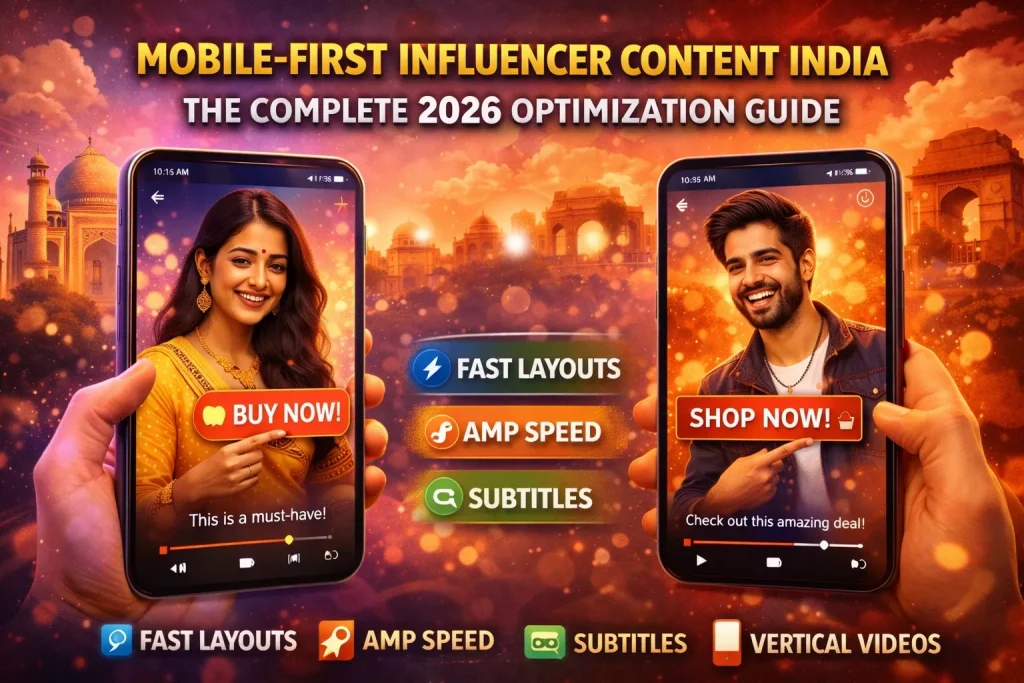
Did you know that 78% of India’s digital advertising revenue now comes from mobile devices? If your influencer campaigns still treat mobile as an afterthought, you’re literally leaving money on the table- and watching competitors capture the attention of over a billion smartphone users scrolling through their feeds right now.
Here’s the thing: Creating effective Mobile-First Influencer Content India isn’t just about shrinking desktop campaigns to fit smaller screens. India’s mobile landscape is fundamentally different- with 1.06 billion cellular connections and 481 million Instagram users consuming content in ways that demand entirely new strategies.
Let’s transform your influencer strategy for the way India actually uses the internet.
Understanding Mobile-First Influencer Content India: Why Your Strategy Must Change
Mobile-First Influencer Content India represents more than a trend- it’s the new baseline reality for digital marketing in the world’s fastest-growing internet market.
When we talk about mobile-first in India, we’re describing an ecosystem where 95.6% of broadband connections are mobile-enabled and the average user spends 3.5 hours daily consuming video content on handheld devices. This isn’t a secondary channel. It’s the channel.
Three Data-Driven Insights Reshaping Mobile-First Influencer Content India
1. The Mobile Dominance Gap Is Widening, Not Closing
India’s 72.5% mobile penetration rate covers over a billion active connections- and Instagram’s 22.9% year-over-year growth is adding millions of users who’ve never experienced desktop social media. These users don’t “prefer” mobile; they exclusively consume content vertically, in portrait mode.
What this means for your campaigns: Design influencer content only for mobile first, then adapt for desktop if necessary- never the reverse.
2. Mobile Ad Revenue Dominates, But Per-Capita Spend Reveals Opportunity
Mobile advertising captures 81.8% of India’s digital revenue, yet per-capita adspend sits at just $8.53 versus the global average of $134. This gap signals an undersaturated market where early adopters of mobile-first influencer strategies can capture disproportionate attention at relatively low costs- giving you a narrow window to establish dominance before competitors catch up. Learn more about budget allocation at Micro vs Macro Influencer Budget in India: Where to Invest for Maximum Impact.
3. Platform Behavior Dictates Content Format
The rise of short-form vertical video is a direct response to how India’s mobile users behave. With Instagram Reels and YouTube Shorts driving most engagement, Mobile-First Influencer Content India must prioritize 9:16 aspect ratios, 15-second narratives, and thumb-stopping hooks within the first three seconds.
Actionable Benchmark: Audit your influencer campaigns and target 80%+ mobile traffic. If you’re below that threshold, your strategy needs immediate mobile-first restructuring.
Designing Mobile-First Influencer Landing Pages That Actually Convert
Here’s where most influencer campaigns fail: They drive mobile traffic to landing pages designed for desktop experiences. The result? Sky-high bounce rates and conversion rates that make your CFO question the entire influencer budget.
What’s the best way to design landing pages for mobile-first influencer campaigns? Start with thumb reach, not mouse clicks.
Four Micro-Optimizations That Transform Mobile Landing Pages
1. Thumb-Friendly CTA Placement
Your call-to-action buttons need to live within the natural thumb zone- that reachable radius from the bottom corners where users can tap without repositioning their grip.
Place primary CTAs 15-20% from the bottom edge on 6-inch devices, with button sizes of at least 48×48 pixels to accommodate larger fingers or on-the-go navigation.
Real-world impact: Brands repositioning CTAs to thumb-friendly zones consistently see 35-48% higher tap-through rates on mobile.
2. Compressed Images Without Quality Loss
Mobile users in India often navigate on variable 4G connections- every kilobyte matters.
Convert images to WebP format and compress to under 100KB per asset using tools like Squoosh or ImageOptim, reducing file sizes by 30-40% without sacrificing quality. For influencer hero images, use srcset attributes to serve appropriate resolutions by device.
The payoff: Pages load 30% faster, cutting bounce rates and improving Core Web Vitals scores that directly impact search rankings.
3. Sticky Navigation That Follows the Scroll
If your navigation disappears after the first screen, you’ve created unnecessary friction between users and conversions. Implement a sticky header with a compressed menu and a persistent primary CTA that never leaves the viewport.
Data shows sticky navigation reduces bounce rates by 25% by keeping conversion pathways constantly accessible.
4. Single-Column, Vertically-Stacked Layouts
Multi-column grids force horizontal scrolling and cognitive overload on small screens. Stack all elements vertically in a single column, prioritizing your headline, value proposition, and CTA within the first two screen heights. Use generous white space between sections to prevent accidental taps.
Pro tip: Test on actual devices, not just browser emulators- physical thumb reach, glare, and one-handed navigation reveal UX issues that desktop testing misses. Learn more about building effective campaign foundations at Build an Influencer Brief That Gets Results (Step 2 of 7).
Optimizing Vertical Video for Mobile-First Influencer Content India
Vertical video isn’t just a format preference- it’s the native language of mobile-first audiences. When 80% of users watch video with sound off and scroll past content within 1.7 seconds if it doesn’t immediately grab attention, your vertical video strategy becomes make-or-break for Mobile-First Influencer Content India campaigns.
Instagram Reels and YouTube Shorts: The Dos and Don’ts
DO: Embrace Full 9:16 Framing
Design every frame for vertical consumption, keeping key elements in the center-vertical third. Full-screen 9:16 content delivers 25% higher view-through rates than cropped horizontal content.
DON’T: Repurpose Horizontal Content with Lazy Crops
Cropping 16:9 to 9:16 wastes 40% of screen real estate and signals to audiences that the content wasn’t made for them—undermining the authenticity influencer marketing depends on.
DO: Add Subtitles in Hindi and English
80% of mobile video is watched on mute. Bold, high-contrast bilingual subtitles keep viewers engaged and expand reach to both urban English-preferring and Hindi-dominant tier-2/3 audiences. Learn more about reaching these audiences here.
DON’T: Use Low-Contrast Text Overlays
Thin or subtle text disappears on mobile screens. If it can’t be read in three seconds, viewers scroll past.
DO: Hook Viewers in the First Three Seconds
Open with a face, a provocative question, or a visually striking moment. Strong 3-second hooks drive 20% higher completion rates.
DON’T: Open with Logos or Slow Builds
Lead with the payoff. Logo animations and fade-ins are conversion killers on mobile feeds.
DO: Create Loopable 15-Second Clips
Loopable content generates multiple views per session, boosting algorithmic performance. Design narratives that end where they begin.
DON’T: Front-Load Static Intros
Every second without movement or dialogue increases abandonment. Get to the point immediately.
For Indian mobile audiences specifically, prioritize local language subtitles, culturally relevant visuals, and influencers whose aesthetic matches your audience’s aspirational identity. Execute Content Production & Approvals Smoothly (Step 5 of 7).
Speed and Engagement Optimization for Mobile-First Influencer Content India
Technical performance separates campaigns that convert from those that hemorrhage traffic before users even see your content. In India’s mobile ecosystem- where connection speeds vary dramatically between metro 5G and rural 4G networks- speed optimization isn’t optional.
Five Quick Wins That Dramatically Improve Mobile Performance
1. Implement Accelerated Mobile Pages (AMP) for Influencer Landing Pages
AMP strips unnecessary code and prioritizes content delivery, resulting in pages that load in under one second even on slower connections. For influencer campaigns driving traffic from Instagram or YouTube, AMP versions can reduce Time to First Byte (TTFB) by 60-70%.
The trade-off: Limited design flexibility. The payoff: Bounce rates that drop by 40% and mobile search rankings that improve measurably within weeks.
2. Lazy-Load Videos and Images Below the Fold
Don’t force mobile devices to download every asset on page load. Implement lazy loading for any content that appears below the initial viewport- videos, images, even embedded social feeds.
This technique prioritizes above-the-fold content, delivering perceived load times under 1.5 seconds while actual full-page loads happen progressively as users scroll.
3. Prefetch Critical Influencer Assets
If your campaign drives traffic to specific landing pages, use DNS prefetching and resource hints to load critical assets (fonts, hero images, primary scripts) before users even click through.
Add <link rel="dns-prefetch" href="//your-cdn.com"> to page headers for influencer content hosted on CDNs. This shaves 200-400 milliseconds off initial load times- enough to reduce bounce rates by 10-15%.
4. Optimize Video Encoding for Mobile Bandwidth
Serve adaptive bitrate streams that adjust quality based on connection speed. Use H.265 (HEVC) encoding for 40-50% better compression than H.264 at equivalent quality levels.
For influencer video content, create multiple renditions: 1080p for WiFi/5G, 720p for stable 4G, and 480p for variable connections. Let the player automatically select the appropriate version.
5. Minimize Third-Party Scripts and Tracking Pixels
Every analytics tag, social pixel, and third-party widget adds HTTP requests that slow mobile load times. Audit your influencer landing pages and ruthlessly eliminate non-essential scripts.
Use Google Tag Manager to load scripts asynchronously and implement server-side tracking where possible. The goal: Reduce total page weight to under 1MB for mobile-first experiences.
What’s the fastest way to improve mobile page speed for influencer campaigns? Start with image compression and lazy loading- these two tactics alone typically improve load times by 30-40% with minimal development effort.
Measuring Success: Mobile-Specific KPIs for Influencer Content India
Traditional desktop metrics don’t translate directly to mobile-first campaigns. You need different benchmarks.
Key Performance Indicators That Matter for Mobile-First Influencer Content India
Mobile Conversion Rate by Device Type: Track conversions separately for iOS vs. Android, and segment by screen size. India’s Android dominance (85%+ market share) means your campaigns must perform exceptionally well on mid-tier Android devices, not just flagship iPhones.
Thumb-Reach Heatmaps: Use tools like Hotjar or Microsoft Clarity to visualize where mobile users actually tap. If your CTAs aren’t showing concentrated heat, they’re positioned incorrectly.
Video Completion Rates by Duration: Monitor how completion rates change at 3-second, 8-second, and 15-second marks. These inflection points reveal exactly where you’re losing mobile attention and where your hooks need strengthening.
Page Speed by Network Type: Segment performance data by connection type (5G, 4G, 3G). If your pages only perform well on premium connections, you’re excluding massive portions of India’s mobile-first audience.
Scroll Depth on Mobile Landing Pages: Track how far down users scroll before bouncing. If 70% never scroll past the first screen, your above-the-fold content isn’t compelling enough- or your page speed is killing engagement before it starts. You can read more about comprehensive performance tracking at Track & Optimize Influencer Marketing Campaigns (Step 6 of 7).
Bringing It All Together: Your Mobile-First Influencer Content India Action Plan
The opportunity in India’s mobile-first market is massive, but the window for early-mover advantage is narrowing as more brands recognize the shift.
Start with these three immediate actions:
First, audit your existing influencer campaigns against mobile-first principles. Calculate what percentage of traffic comes from mobile devices, measure mobile-specific conversion rates, and identify the biggest gaps between mobile and desktop performance.
Second, redesign one high-traffic influencer landing page using the thumb-friendly, speed-optimized principles outlined above. A/B test it against your current version and measure the impact on mobile conversion rates.
Third, work with your influencer partners to create one piece of native vertical video content designed specifically for mobile feeds- 9:16 framing, 3-second hook, bilingual subtitles, 15-second duration. Track completion rates and engagement against your existing content.
Mobile-First Influencer Content India isn’t a future trend you can plan for next quarter. It’s the current reality of how over a billion users consume content, engage with brands, and make purchasing decisions. The brands winning in this market aren’t the ones with the biggest budgets- they’re the ones who design for thumbs, optimize for variable connections, and create content in the vertical, bite-sized formats that mobile-first audiences actually want.
Your competitors are still figuring this out. You just got the playbook.
TL;DR
• Audit your Mobile-First Influencer Content India campaign traffic; optimize for 80%+ mobile visitors.
• Position CTAs within thumb-reach zones (15–20% from bottom) to boost taps.
• Compress images under 100KB in WebP and lazy-load below-the-fold assets.
• Create 9:16 vertical videos with 3-second hooks and bilingual subtitles for engagement.
• Enable AMP and prefetch critical assets to slash mobile load times under two seconds.
For more information or to get in touch with us, please feel free to reach out to OTBOX at otboxmediasolutions@gmail.com