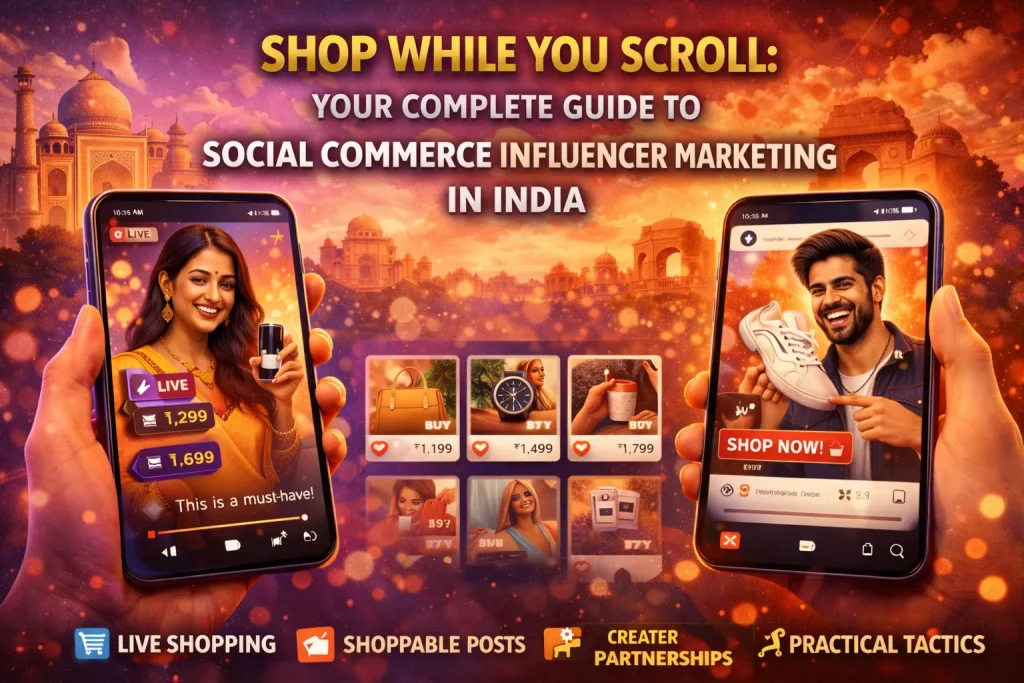
By 2026, India’s social commerce market is experiencing explosive growth, with influencer marketing projected to reach INR 3,375 crore—a 25% compound annual growth rate that far outpaces traditional digital advertising channels growing at 12-15%. For direct-to-consumer (D2C) brands, the convergence of live shopping, shoppable posts, and creator partnerships represents the fastest path to conversion in India’s booming creator economy.
Here’s the thing: your customers aren’t just discovering products on social media anymore—they’re buying directly from their feeds. And the brands winning this game? They’re leveraging social commerce influencer marketing to turn casual scrollers into instant buyers.
What Is Social Commerce Influencer Marketing and Why It Matters Now
The opportunity is immediate: India’s influencer marketing ecosystem now comprises 3.5 to 4.5 million content creators reaching over 500 million active social media users. More critically, over two-thirds of Indian consumers now rely on influencers for product discovery and purchase decisions—a fundamental shift in how buying behavior occurs.
Social commerce influencer marketing combines the trust and authenticity of creator content with seamless in-app purchasing. Rather than requiring consumers to leave social platforms to complete transactions, shoppable influencer content enables checkout through features like Instagram Shopping tags, live commerce streams, and creator storefronts.
This isn’t just another marketing channel—it’s a complete reimagining of the purchase journey.
Traditional e-commerce forces consumers through multiple steps: see product → remember it → search for it → navigate to website → find product again → checkout. Social commerce collapses this entire funnel into a single tap. When an influencer showcases your product during an Instagram Live session, viewers can purchase without ever leaving the stream.
The numbers back this up: Industry benchmarks show influencer marketing delivers an average of $5.78 in revenue for every $1 spent, with optimized campaigns achieving even higher returns. For social commerce specifically, the ROI advantage is compounded because you’re eliminating decision friction at the exact moment of peak interest.
But wait—there’s a critical nuance here. Not all influencer partnerships drive direct sales. The social commerce influencer marketing approach differs fundamentally from traditional awareness campaigns. You’re not just seeking impressions or brand mentions; you’re building a direct sales channel where influencers function as digital storefronts. You can read more about establishing clear performance objectives at Define Influencer Marketing Goals & Audience (Step 1 of 7).
Key Social Commerce Platforms & Features in India
Choosing the right platform for your influencer-driven social commerce strategy determines your success before you even select creators. Each platform offers distinct features, audience demographics, and commerce capabilities.
Here’s what you need to know:
| Platform | Primary Strength | Influencer Feature | Best For |
|---|---|---|---|
| Instagram Shopping | Lifestyle, beauty, fashion reach | Shoppable posts, Instagram Live Shopping tags, creator storefronts | High-engagement lifestyle D2C brands targeting 18-35 demographic |
| YouTube | Long-form trust-building | Shopping shelf integration, product links in descriptions | Educational content, tutorials, detailed product reviews |
| Meesho | Tier-2/3 audience penetration | Creator commission model, live shopping integration | Budget-conscious consumers, value-driven products |
| ShareChat/Moj | Regional language dominance | Native commerce integration, micro-influencer networks | Vernacular audiences, culturally specific products |
| Flipkart Live | E-commerce trust factor | Live shopping with instant checkout | Electronics, home goods, established brand partnerships |
How to Choose Your Platform Match
Your product category and target audience should drive platform selection, not just where you’re already active.
For premium lifestyle products (skincare, fashion, wellness), Instagram Shopping provides the most sophisticated creator tools. Influencers can tag multiple products in a single post, create dedicated storefronts featuring your entire catalog, and host live shopping sessions where viewers purchase in real-time.
For products requiring education or demonstration (tech gadgets, cooking equipment, fitness gear), YouTube’s long-form format builds deeper trust. The platform’s shopping shelf appears directly below videos, allowing creators to reference specific products during tutorials while viewers shop without interrupting the content.
For value-conscious segments in Tier-2 and Tier-3 cities, Meesho’s reseller model turns influencers into commission-earning partners. This aligns incentives perfectly—creators actively promote products because their earnings scale with sales, not just engagement metrics. You can read more about tapping into these high-growth markets at Regional Influencers: India’s Non-Metro Key.
The mistake most D2C brands make? Spreading efforts across all platforms simultaneously. Start with one platform where your ideal customer already spends time and where your product naturally fits the content format.
Step-by-Step Influencer Strategy for Live & Shoppable Content
How to launch a shoppable influencer live event in 5 steps:
Step 1: Discovery and Vetting (Week 1)
Identify creators whose audience demographics match your ideal customer profile, not just follower counts. Use platform analytics tools to verify:
– Audience location (prioritize creators with 60%+ followers in your target cities)
– Engagement rate (aim for 3-8% for micro-influencers, 1-3% for larger creators)
– Previous commerce content performance (request case studies or past campaign metrics)
– Audience authenticity (check for sudden follower spikes or suspicious engagement patterns)
Pro tip: Nano-influencers (1,000-10,000 followers) in niche categories often deliver higher conversion rates than mega-influencers because their recommendations carry stronger personal credibility. You can read more about comprehensive vetting methodologies at Practical Influencer Vetting Framework.
Step 2: Partnership Structuring (Week 1-2)
Design compensation models that align with social commerce outcomes:
– Hybrid commission model: Base fee + percentage of sales (typically 10-20% of revenue generated)
– Product seeding with performance bonuses: Free products plus tiered bonuses for hitting sales milestones
– Exclusive discount codes: Creators earn higher commissions when their unique codes drive purchases
The key is tying compensation to conversions, not vanity metrics. When influencers earn more by driving actual sales, they’re incentivized to create compelling calls-to-action and optimize content for purchasing behavior.
Step 3: Content Planning and Technical Setup (Week 2-3)
Work collaboratively with creators to plan content that balances authenticity with conversion optimization:
- For live shopping events: Schedule 60-90 minute sessions during peak audience activity hours (typically 8-10 PM on weekdays, 3-6 PM on weekends)
- For shoppable posts: Identify 3-5 hero products to feature with clear product tags
- For creator storefronts: Curate collections that tell a story (e.g., “My Evening Skincare Routine” rather than random product assortments)
Technical requirements vary by platform, but most require:
– Business account status for your brand
– Product catalog upload (with high-quality images, descriptions, pricing)
– Commerce account approval (Instagram/Facebook typically takes 1-3 business days)
– Creator access permissions to tag your products
You can read more about structuring effective creative guidelines at Build an Influencer Brief That Gets Results (Step 2 of 7).
Step 4: Launch and Real-Time Optimization (Event Day)
During live shopping events, monitor performance metrics and adjust in real-time:
- Track viewer count, engagement rate, and product tag clicks every 15 minutes
- Adjust product showcasing based on what’s generating interest (spend more time on items getting questions)
- Deploy limited-time offers mid-stream to create urgency (“Next 10 buyers get 25% off”)
- Respond to comments and questions immediately to maintain momentum
Have your team ready to handle backend issues—inventory updates, checkout problems, or technical glitches can kill conversion momentum if not addressed within minutes. You can read more about real-time campaign optimization at Track & Optimize Influencer Marketing Campaigns (Step 6 of 7).
Step 5: Post-Event Retargeting and Analysis (Week Following Event)
The sale doesn’t end when the live stream stops. Implement systematic follow-up:
- Repost stream highlights with product tags to reach followers who missed the live event
- Create Stories featuring viewer testimonials and unboxing content
- Run retargeting ads to viewers who engaged but didn’t purchase
- Send personalized discount codes to high-engagement viewers who abandoned checkout
Analyze performance across the full funnel:
– Reach → Engagement rate → Product tag clicks → Add-to-cart rate → Purchase completion rate
Identify drop-off points to optimize future campaigns. If product tag clicks are high but purchases low, your checkout experience may need simplification. If engagement is low, content quality or timing needs adjustment.
Best Practices & Real Results from Indian D2C Brands
Let me show you what this looks like in practice.
Case Study: Beauty Brand Achieves 312% ROI Through Instagram Live Shopping
An emerging Indian skincare brand partnered with five micro-influencers (15,000-50,000 followers each) for a coordinated Instagram Live Shopping event. The strategy:
- Synchronized live sessions over a single weekend, each focusing on different product benefits
- Exclusive 30% discount available only through live shopping tags
- Limited inventory (100 units per influencer) to create scarcity
- Post-live Stories featuring customer testimonials and restock announcements
Results over 72 hours:
– 8,200 live viewers across five sessions
– 1,847 product tag clicks
– 423 completed purchases
– Average order value: ₹1,650
– Total revenue: ₹6,97,950
– Campaign cost (influencer fees + product costs): ₹2,23,500
– ROI: 312%
What made this work? The brand didn’t just throw products at influencers and hope for sales. They created a coordinated event with clear scarcity mechanics, exclusive incentives, and systematic follow-up.
Replicable Best Practices for Social Commerce Influencer Marketing
Timing optimization:
– Launch live events during platform peak hours specific to your audience (use Instagram Insights to identify when your followers are most active)
– Avoid major holidays or events that compete for attention
– Test different days of the week—B2C lifestyle brands often see higher conversion on weekday evenings when consumers are relaxing at home
Call-to-action phrasing that converts:
– Specific beats generic: “Tap the product tag to get this serum at 30% off for the next hour” outperforms “Link in bio”
– Create urgency without being pushy: “We only have 50 units available tonight” works better than aggressive sales language
– Make instructions crystal clear: Many viewers are new to social commerce and need explicit guidance on how to complete purchases
Product tag usage strategy:
– Limit tags to 3-5 products per post to avoid overwhelming viewers
– Tag products at the exact moment the influencer demonstrates them in video content
– Use carousel posts to showcase before/after results with product tags on the “after” image
Post-live retargeting sequence:
– Within 24 hours: Share highlights reel with product tags to reach followers who missed the live event
– 48-72 hours: Stories featuring early customer reviews and unboxing videos
– One week later: “Restock alert” for products that sold out during the live event
The common thread? Every tactic reduces friction between interest and purchase while maintaining authentic creator voice.
Measuring Success & Scaling Your Social Commerce Influencer Strategy
You can’t optimize what you don’t measure. Social commerce influencer marketing requires tracking metrics across the entire funnel, not just vanity metrics like reach or likes.
Essential KPIs to monitor:
Conversion metrics:
– Product tag click-through rate (benchmark: 2-5% for shoppable posts, 8-15% for live shopping)
– Add-to-cart rate from product tags (benchmark: 15-25% of clicks)
– Purchase completion rate (benchmark: 40-60% of add-to-carts)
– Average order value from influencer-driven sales vs. overall AOV
Engagement indicators:
– Live viewer retention rate (percentage who stay for 50%+ of stream)
– Comment rate during live events (higher engagement correlates with higher conversion)
– Save rate on shoppable posts (indicates purchase intent for later)
– Share rate (organic amplification that extends reach beyond paid partnership)
Economic performance:
– Cost per acquisition through influencer channel vs. other paid channels
– Customer lifetime value of influencer-acquired customers (often higher due to trust transfer)
– Return on ad spend for influencer partnerships
– Incremental revenue attributed to social commerce vs. baseline
You can read more about comprehensive ROI calculation frameworks at How to Calculate Influencer Marketing ROI: A Step-by-Step Guide for Indian Brands.
How to Set Up Your Tracking Infrastructure
Platform-native analytics:
Instagram Insights provides basic commerce metrics—product tag clicks, storefront visits, and checkout initiations. Access these through your professional dashboard under “Shopping” analytics.
Google Analytics 4 integration:
Create unique UTM parameters for each influencer partnership to track:
– Traffic source (which creator drove visits)
– Campaign performance (live event vs. shoppable post vs. storefront)
– Conversion paths (how many touchpoints before purchase)
– Assisted conversions (influencer content that contributed to sales but wasn’t the final click)
Influencer-specific tracking:
Provide unique discount codes to each creator (e.g., CREATOR15 for 15% off). This enables precise attribution even when platform analytics are limited. Track redemption rates, average order values, and customer retention by code.
Dashboard template for continuous optimization:
Create a weekly scorecard tracking:
1. Total revenue from social commerce influencer partnerships
2. Cost per acquisition by creator tier (nano/micro/macro)
3. Conversion rate by platform (Instagram vs. YouTube vs. others)
4. Customer acquisition cost vs. customer lifetime value ratio
5. Repeat purchase rate from influencer-acquired customers at 30/60/90 days
Review this dashboard weekly for the first month of campaigns, then bi-weekly once patterns emerge. Look for creators and content formats that consistently outperform benchmarks—these become your scaling opportunities.
Scaling What Works
Once you’ve identified high-performing creator partnerships and content formats, scale systematically:
Deepen relationships with top performers: Convert one-off campaigns into ongoing partnerships with monthly retainers plus performance bonuses. Long-term creator relationships build stronger audience trust and reduce negotiation overhead.
Replicate successful formats across similar creators: If a specific live shopping format drove exceptional results with one influencer, create a playbook and recruit creators with similar audience profiles to execute the same approach.
Expand to complementary platforms: After mastering Instagram Shopping, test the same creator partnerships on YouTube Shorts with shopping shelf integration or explore regional platforms like ShareChat for vernacular audience expansion.
Build a creator affiliate program: Transition from campaign-based partnerships to an always-on affiliate model where creators earn commissions on all sales generated through their unique links or codes, regardless of whether it’s part of a formal campaign. You can read more about transforming campaign insights into long-term strategy at Analyze & Build Campaign Learnings Report (Step 7 of 7).
Your Next Steps: Launching Your First Social Commerce Influencer Campaign
The brands winning in India’s social commerce revolution aren’t waiting for perfect conditions—they’re testing, learning, and scaling what works.
Here’s your action plan for the next two weeks:
Week 1: Select your primary platform based on where your ideal customer already engages with similar products. Set up your commerce infrastructure—business account, product catalog, and creator partnership terms. Identify 3-5 potential influencer partners using the vetting criteria outlined in Step 1.
Week 2: Reach out to creators with a clear partnership proposal that includes compensation structure, content expectations, and success metrics. Plan your first shoppable content piece or live shopping event with your top-choice creator. Set up tracking systems so you can measure results from day one.
The social commerce influencer marketing opportunity in India won’t stay this accessible forever. As more brands pile into the space, creator costs will rise and audience attention will fragment. The advantage goes to brands who build authentic creator relationships and optimize their conversion funnels now, while the channel is still maturing.
Start with one platform, one creator, and one well-executed campaign. Measure everything. Scale what works. Your customers are already scrolling—give them something worth buying.
TL;DR
• Pick one social platform matching your audience to maximize Social Commerce Influencer Marketing effectiveness.
• Use commission-based payment tied to sales to align Social Commerce Influencer Marketing goals.
• Schedule live shopping during peak hours and highlight 3-5 hero products for instant buys.
• Retarget viewers with exclusive discount codes and post-live highlights within 24 hours.
• Track product tag clicks, add-to-cart rates, and optimize content in real time.
For more information or to get in touch with us, please feel free to reach out to OTBOX at otboxmediasolutions@gmail.com